Wednesday, May 24, 2017

Lucy's Summer by Donald Hall

   Lucy's Summer tells the story of two sisters who live in rural New Hampshire with their mother who is a milliner. Lucy's Summer has all the charm and sweetness of a bygone era and it will make you want to transport back into the early 1900s to experience some of what Caroline and Lucy experience.

   The girls, Lucy and Caroline, help with the canning and food preservation and watch their mother as she makes new hats for the surrounding farm families. At one point they take the "peanut" train to Boston for hat inspiration and eat oyster stew, frankfurters and Boston baked beans for the first time in their lives.

donald hall 
Donald Hall

   Lucy's Summer is illustrated by Michael McCurdy's stunning wood engravings. McCurdy
also illustrated Hannah's Farm which has been a great favorite around here for years and American Tall Tales by Mary Pope Osborne (of Magic Treehouse fame). Oh, and how could I forget! Lucy's Summer and Lucy's Christmas are also treasures!

    Donald Hall is the author and quite the author in his own rite. He currently resides in New Hampshire in a farm house. I love his poetry and cry every time I read Green Farmhouse Chairs. It reminds me so of my grandparent's farm in the Central Valley.

Monday, May 22, 2017

No. Six Depot

    I am always in search of the perfect cup of coffee. Not just a great cup of coffee, but the perfect up. Perfection in a mug with a trickle of cream. The cream should enhance the delicious roasty flavor, not cover up bitterness or poor bean quality.

    No. Six Depot in West Stockbridge, Massachusetts delivers just such a cup. On brew the morning I was there was a roast called Heart of Darkness (which of course I had to try since I was on a literary road trip) and it truly lived up to its name with it's deep, rich dark roast. It was delightfully nutty with a buttery rich taste to it. Brewed to perfection, I enjoyed it with a flaky, just made, croissant.


No. Six Depot isn't just a coffee shop. It is a gallery, a store and a roastery all rolled into one. Flavio Lichtenthal is the owner and roaster along with Lisa Landry who curates the gallery and does the tea importing. I sat out in the shade of a red umbrella and journaled about my couchsurfing experience with Mischa the night before. It was a glorious morning.

Wednesday, May 17, 2017

Women Reading

    I love it that Pinterest has introduce me to such amazing art. Especially depictions of people reading! I'm going to give  you a platter of delicious pictures of women reading in this post. I will include the artist, date and current location whenever possible.
Jerry Weiss, Susan (Summer Reading), 1986. Oil on canvas, 30 x 36 in.:
Susan Summer Reading, Jerry Weiss, 1986


Emma Ersek:
Untitled, Emma Ersek


Edouard Vuillard, Lucy Hessel Reading (1913), oil on canvas, (Photo by The Jewish Museum:
Lucy Hessel Reading, Edouard Vuillard, 1913 (The Jewish Museum)

Reading, Sonya Redway


Lesende, Louise Catherine Brelau, 1889

InteriorHerbert Ashwin Budd, The Potteries Museum and Art Gallery 


Reading With Cat, Anita Ree


Girl Reading Harold Knight:
Girl Reading, Harold Knight


Tuesday, May 16, 2017

Books of Things

   Oh gosh do I ever love books of things. Like books where each page has a theme or where the whole book has a theme. Love them. Love. Them.
   I just recently got this new book called Encycolpedia of Rainbows: Our World Organized By Color by Julie Ream. I'm not ashamed to say I've poured over it for two weeks now any chance I get. It is a treasure for the eyes. Truly delightful.


Monday, May 15, 2017

The Boy, The Baker, The Miller, and More

   This book is a new fav of ours. The Boy, the Baker, The Miller, and More by Harold Berson. It reminds me a lot of Pele's New Suit by Elsa Beskow. A child wants something. They ask and elder for it. The elder says, "I'll give it to you if you find me such and such..." It's an age old storytelling construct and one that children, especially in the five to ten age range love. Harold Berson's illustrations are charming in this book. Unfortunately, I found it as a discard so I'm not sure if its very widely available. 


Saturday, May 13, 2017

Book Talk Post: Kingsolver, The Farm, and Breasts

Book talk time. What have I been reading?

A lot!

I just finished Barbara Kingsolver's Prodigal Summer, and, ok folks, lets talk here. There really is no question in my mind--and there really shouldn't be in yours either--Barbara Kingsolver is truly the most eloquent, most diverse, best writer of America in our times. Am I right? I mean, maybe Margaret Atwood would challenge Kingsolver in a battle of objective character formation, but I really don't think so. And strangely enough, I was first introduced to Kingsolver in one of her least erudite books, Animal, Vegetable, Miracle. It was in 2008 just after Josephine was born. I kept from falling into the depths of postpartum insanity (I was severely depressed) by listening to poetry and books on tape while walking with both girls in our hand-me-down red jogging stroller. We walked all over our city. We walked. And walked. And walked. I walked myself slowly out of the darkest time I had ever experienced in my twenty-five years. And I listened and thought and took myself out of my dark, scary cave of depression by consciously focusing on the words being read to me. I imagined one of my sisters next to me, reading aloud as we walked (which was silly, who reads as they walk? Um, me. Guilty). I learned to nurse Josephine in the Guatemalan woven sling as I kept walking. Not even stopping to feed her...I was healing myself as I listened and walked and nourished my babe. Clare would be babbling in the stroller about everything and nothing. I could hear her just enough to follow what I was listening to and also tune in to her needs.

   Anyway, I listened to Animals, Vegetable, Miracle and loved Kingsolver's drive to explore her world in the context of her beliefs and dreams. I too dreamed of moving to a farm somewhere on the east side of the Mississippi and growing food to feed my family. It seemed so unreachable at the time. We were living in a two bedroom upstairs apartment with a teeny tiny balcony patio. Our lives were very controlled, very prescribed in what we could and couldn't do.  I loved Kingsolver's words and the glimpse into her soul through her writing.

   Actually, as I'm writing and thinking about this, Animal, Vegetable, Miracle wasn't the first Kingsolver book I read. No, it was actually The Poisonwood Bible. How could I forget reading that?! I was eighteen and had just graduated from high school. I was spending the summer staying with my grandparents off and on and helping them around the farm. I fixed the sprinkler system with my Grandpa Farmer (I remember wearing a red linen skirt and feeling so farm-womanish and it got muddy while I was digging out a pipe from the weeds with my bare hands and I loved the smell of the wet earth and the sun baking my skin and when we were finished my grandpa went inside for his afternoon nap and I went out to the back black bottomed pool shaded by a locust tree and stripped naked and dove into the pool and lounged with the hot sun touching my baked skin and feeling cool and inseparable from the water lapping about me and I got out and wrapped a towel around me and lay on the antique iron pool lounge chair that was under the hanging grape vine arbor and read my battered copy of The Poisonwood Bible  and I was transported to Africa and it felt strange and delicious all at the same time to be in two places at once.) and gutted the chicken coop spreading new wood shavings down and spraying all the wooden roosts with linseed oil and turpentine. I also gathered countless vegetables from the garden and watered and watered and watered. We planted corn and radishes in succession so they would bear at different times and a Mennonite farmer came by with a couple of chickens as a thank you to my grandpa for some service he had done for them. I ate hundreds of juicy ripe figs and peaches and lusted after the unripe grapes that were everywhere just begging to be picked. We ate dinner in the old downstairs family room on the same round wooden table that my mom had eaten on as a kid and I helped myself to seconds and thirds. I was so starving after working all day. I slept upstairs in my Aunt Jane's old room. It was patterned with dark red sprigged wall paper and antique lady's hats hung from nails on the sloping attic like ceiling. It was hot, even in the cool of the night. Often, I would make a pretense of going to bed when my grandparents would and then I'd sneak out down the stairs, avoiding the creaks--I knew exactly where they were--and tiptoed out the back door to again strip to my skin and slip into the black inky water of the pool. I wouldn't be able to stay in for long since my imagination would get the better of me and I would think up all kinds of horrors coming at me from the depths of the water. But once I was wet and cooled off I could slink back to bed nice and cool and my wet ropes of hair would air condition me for the rest of the night.

   On the farm, in the summer, no one ever slept in. I was up at first light. I always slept so heavy and soundly. I would go outside and walk around in the dew-wet grass and smell the morning smells. Then I would go inside and Grandma would have coffee that had percolated on the stove. I always drank from the same, chunky restaurant ware mug with the green band around it. Usually two cups, maybe three. Breakfast was cold cereal. Then the days work would start. Around eleven, Grandpa would go into the house and lay out a smorgasbord of bread, pickles, onions, cheese, fruit, huge torn off hunks of iceberg lettuce and cookies. As far as I could tell, he didn't seem to eat much. I relished the food and ate copious amounts. I think my grandparents liked to see someone eating what they were so generously offering. It felt good to be getting positive attention for eating. And my metabolism was running on high at the time. I was eating huge meals but losing my early teens pudge. My thighs were becoming even more muscled from the work and also all the hockey I was playing back at home. I kept hoping I would lose weight in my breasts--I so badly wanted to have smaller breasts. I was a double D and felt like all my breasts did was get in the way. I would bind them in with two sports bras when I played hockey. I absolutely HATED that part of my body. That all changed when I breastfed Clare for the first time. Suddenly I was in awe of my huge milk producing machines!
   But back to Barbara Kingsolver. Geez, I am NOT good at staying on topic. Anyway, I've loved all of her books, although I couldn't finish The Bean Trees for some reason. I'm going to reread Small Wonder soon. Her writing is like a whole meal: vegetable, meat, sauce, salad, bread and dessert all rolled into one.

Wednesday, May 10, 2017

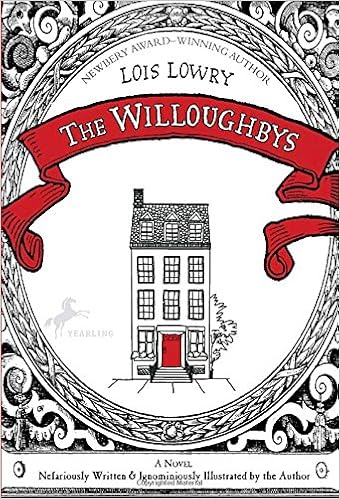
The Willoughbys

Image result for the willoughbys   The girls and I just finished reading Lois Lowry's The Willoughbys. In truth, we almost stopped the second night of reading. I was so turned off by the children's awful behavior. Somehow I hadn't gotten the memo that the book was a parody of traditional British children's books. After realizing that--rather, going on Goodreads to see "what the heck" the book was all about!--we raced through it pretty quickly. The girls found certain parts hilarious like the naming of the abandoned baby, and also the candy bar (Baby Ruth). And I think the quote, "It makes me want to womit," will forever be a part of our family's inside joke quote vernacular. I really enjoyed this NPR podcast with Lois Lowry. It was so fun!

   Here is the Goodreads description:
Abandoned by their ill-humored parents to the care of an odious nanny, Tim, the twins, Barnaby A and Barnaby B, and their sister, Jane, attempt to fulfill their roles as good old fashioned children. Following the models set in lauded tales from A Christmas Carol to Mary Poppins, the four Willoughbys hope to attain their proscribed happy ending too, or at least a satisfyingly maudlin one. However, it is an unquestionably ruthless act that sets in motion the transformations that lead to their salvation and to happy endings for not only the four children, but their nanny, an abandoned baby, a candy magnate, and his long-lost son too. Replete with a tongue-in-cheek glossary and bibliography, this hilarious and decidedly old-fashioned parody pays playful homage to classic works of children’s literature.

Farm Girl Reading


Unknown artist (Russian, 20th century) - "By the window", 1959 - Springville Museum of Art:

Oh Summer! You Cannot Come Soon Enough!


Monika Luniak:


The Beautiful and the Damned by F. Scott Fitzgerald


The Beautiful and the Damned F. Scott Fitzgerald:

 I've read other Fitzgerald, although never his magnum opus, The Great Gatsby, but after reading The Beautiful and the Damned, I don't think I'm likely to pick Him up again.

   I started out really liking The Beautiful and the Damned. The precise but loping language and structure was a breath of fresh air after just finishing The Age of Innocence (although I loved it!). The novel follows two central figures, Anthony and Gloria, both New York nouveau riche during the early 1900s Jazz Age. The book starts during Anthony's college days and continues on through his courtship and marriage to Gloria, short stint in the military during WWI and subsequent tumble into alcoholism as he awaits a sizable inheritance to come through.

   I initially became involved with the characters and I had an unexplained like for Dick Caramel (don't ask--he was an odd bird, but adorable somehow.). But as the book progressed, I became increasingly annoyed by both Gloria and Anthony. They are both self-centered and shallow. Completely unlikable. I kept hoping some redeeming quality would surface.

   Sadly, it never did.

  I did have a fascination with Dorothy "Dot" Raycroft whom I instantly likened to Ellen Olenska from The Age of Innocence. I'm always fascinated by the females who draw husbands away from their wives in novels. "What makes them so special?"  I always find myself asking.
F. Scott and Zelda Fitzgerald--before the madness and drink truly took over. I don't know why I'm so fascinated by them--but I am.:     Something I always do when reading period novels, especially when I can't seen to find an interest in the characters actions, is to transpose them into modern day. Who would they be? Where would they be in modern life? With Anthony and Gloria, I kept thinking of Orange County wealthy and opulence. The society is so progressed in its insular culture that it believes it is all that exists. I felt that Gloria and Anthony would have moved almost seamlessly into the Southern California Hollywood and famous people world.
   Another tidbit. This novel was the first to be published after Fitzgerald's popular This Side of Paradise. The Great Gatsby follows. It is interesting--this novel sandwiched in-between these two others. Interesting.